Psychological
Pricing Kit
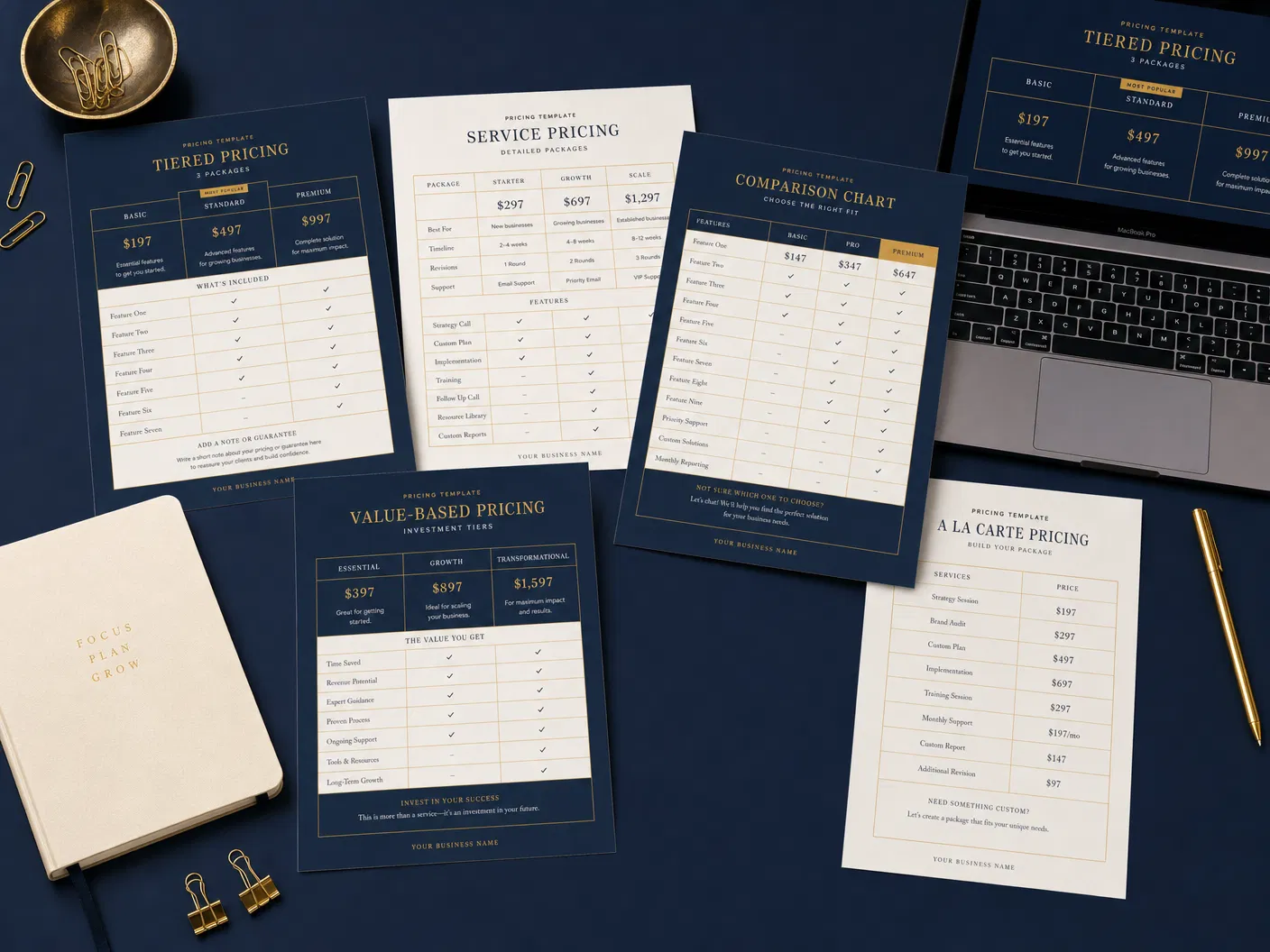
12 ready-to-use pricing templates based on behavioral economics research. Each template includes the psychology behind it, when to use it, and a fill-in-the-blank format you can deploy today.
Why Pricing Psychology Matters
93%
of buying decisions are influenced by visual appearance and pricing presentation
2.5×
stronger — the pain of loss vs. the joy of gain (Kahneman's research on loss aversion)
40%
average increase in premium tier conversions when using the Decoy Effect correctly
The Complete Kit
12 Templates. Instant Results.
Click any template to see the psychology behind it, when to use it, and the key rule for maximum impact.
#1The Decoy Effect
Asymmetric Dominance
The Decoy Effect
Asymmetric Dominance
The Psychology
When given 3 options, people choose the middle one — especially when a 'decoy' makes it look like the best value.
Best For
SaaS pricing, service packages, product tiers
Key Rule
Decoy should be 60-80% more expensive than your target tier but only marginally more valuable.
#2Charm Pricing
Left-Digit Effect
Charm Pricing
Left-Digit Effect
The Psychology
The brain processes the leftmost digit first. $997 feels significantly cheaper than $1,000.
Best For
Products under $10,000 where the buyer is price-sensitive
Key Rule
Under $100 use .97 endings. $100-$1000 use 7 endings. Over $10K use round numbers.
#3Anchor & Contrast
Reference Point Setting
Anchor & Contrast
Reference Point Setting
The Psychology
The first number people see becomes their reference point. Everything after is judged relative to it.
Best For
Sales presentations, proposals, landing pages
Key Rule
Always present the highest number first, then reveal your price as a contrast.
#4The Value Stack
Perceived Value Building
The Value Stack
Perceived Value Building
The Psychology
Listing individual values before the total price makes perceived value far exceed actual price.
Best For
Course launches, bundle offers, service packages
Key Rule
Total value should be 5-10x the actual price. List 5-8 items maximum.
#5The 'Per Day' Reframe
Pain Minimization
The 'Per Day' Reframe
Pain Minimization
The Psychology
Large numbers feel painful. Breaking into daily equivalents makes them feel trivial.
Best For
Subscription services, annual plans, high-ticket items
Key Rule
Always compare to a relatable daily expense (coffee, lunch, Uber ride).
#6Risk Reversal Guarantee
Loss Aversion Counter
Risk Reversal Guarantee
Loss Aversion Counter
The Psychology
People fear losing money more than they desire gaining value. Removing risk removes the biggest barrier.
Best For
Any product or service — especially high-ticket
Key Rule
The stronger your guarantee, the fewer refunds you'll actually get.
#7Payment Plan Psychology
Pain Spreading
Payment Plan Psychology
Pain Spreading
The Psychology
Smaller, spread-out payments feel less painful than one large sum, even when the total is higher.
Best For
High-ticket products ($500+), courses, coaching
Key Rule
Pay-in-full should save 10-15% vs. payment plan total.
#8Urgency Deadline Framework
Action Acceleration
Urgency Deadline Framework
Action Acceleration
The Psychology
Deadlines create action. Without a deadline, 'later' becomes 'never.'
Best For
Limited offers, launches, seasonal promotions
Key Rule
Use cohort-based, price-based, bonus-based, or capacity-based urgency — never fake scarcity.
#9Comparison Anchor Table
Competitive Positioning
Comparison Anchor Table
Competitive Positioning
The Psychology
Positioning against expensive alternatives makes your price feel like a bargain.
Best For
Sales pages, proposals, competitive situations
Key Rule
Compare against 3 expensive alternatives, then present your offer as the clear winner.
#10Investment Language
Perception Shifting
Investment Language
Perception Shifting
The Psychology
Words shape perception. 'Cost' implies loss. 'Investment' implies return.
Best For
All sales conversations, copy, and presentations
Key Rule
Replace every 'cost/price/buy' word with its positive equivalent.
#11Tiered Value Ladder
Progression Path
Tiered Value Ladder
Progression Path
The Psychology
Give people a clear progression path. Each tier makes the next feel like the logical next step.
Best For
Business model design, product ecosystem planning
Key Rule
Start with free, move to low-ticket, then core, premium, and elite.
#12Bonus Stack Deadline
Desire + Urgency Combo
Bonus Stack Deadline
Desire + Urgency Combo
The Psychology
Combining value stacking with time-limited bonuses creates both desire and urgency simultaneously.
Best For
Product launches, limited-time offers, enrollment periods
Key Rule
First 1-2 bonuses are permanent. Last 2 expire. Expiring ones should be most desirable.
Price Smarter.
Sell More.
Stop guessing at your pricing. Use science-backed templates that are proven to increase conversions and average order value.
Get the Pricing KitInstant download. Works for any industry. 30-day guarantee.
Clear answers
Frequently Asked Questions
What is in the Psychological Pricing Kit?
The kit includes 12 fill-in-the-blank pricing templates with explanations, use cases, and key rules. Examples include the Decoy Effect, Charm Pricing, Anchor and Contrast, Value Stack, and tiered offers.
How do I get the pricing templates?
The Psychological Pricing Templates are included in the $47 Masterclass and the Complete Professional Package. They are not the separately priced Slideshow Templates product.
Do the templates guarantee higher conversions?
No. Use them to present real options and value clearly, and test what works with your customers. Results depend on the offer, audience, market, and implementation.
Explore the free sales psychology guide, compare training resources, or read our purchase terms.